


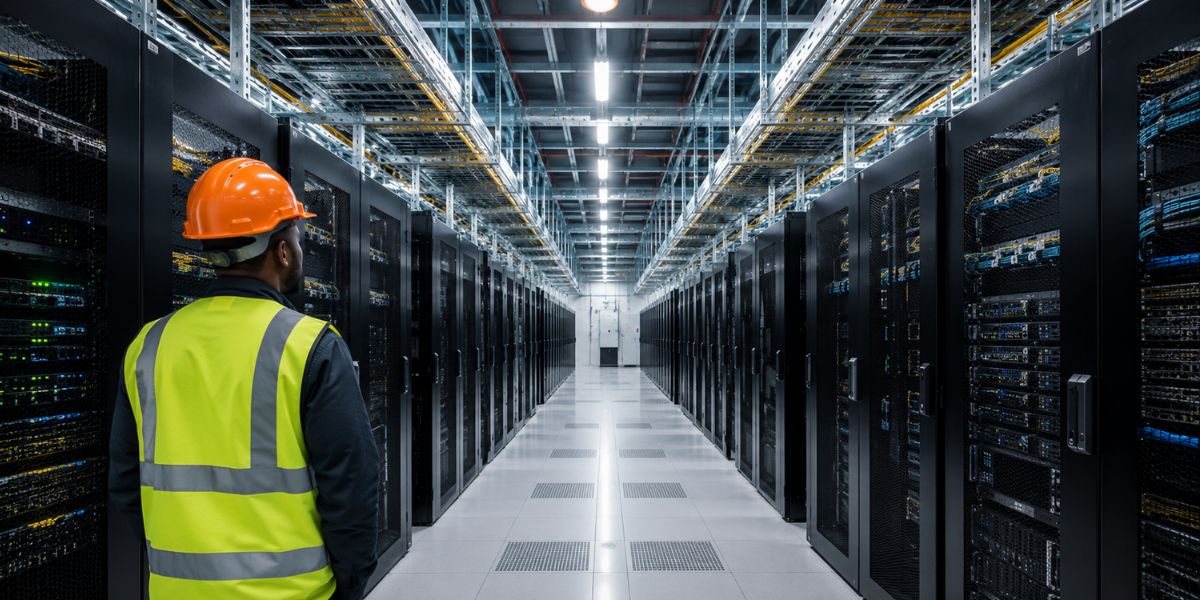
TL;DR: AI adoption across South African banking, retail, manufacturing, and other sectors is straining infrastructure — power, cooling, bandwidth, compliance, and physical security all need to change to support it. What “AI-ready” looks like differs by industry, but the underlying questions are the same everywhere: enough power, enough cooling, fast enough data movement, compliant, and secure.
AI adoption in South Africa isn’t a “someday” conversation anymore — it’s happening right now, across almost every industry we work with. FirstRand, Standard Bank, Nedbank, and Absa are already among Africa’s most advanced AI adopters, using it for fraud detection, cybersecurity, and customer service. Pick n Pay launched “Penny,” a conversational shopping assistant that lets customers build a basket by voice or text. Shoprite has rolled out AI-driven personalisation and inventory tools. Manufacturers and mining operations are using AI to optimise production and predict equipment failure before it happens.
Most conversations about AI focus on the software — the model, the chatbot, the algorithm. But behind every one of those examples sits a quieter, less glamorous question: is the infrastructure actually built to support it?
That’s the part we don’t hear enough about. AI isn’t just changing what businesses can do — it’s changing what AI-ready infrastructure actually requires: their power systems, data centres, cabling, and security need to look like. And that shift plays out differently depending on the industry you’re in.
The Landscape Shift: What’s Actually Changing
Before getting into specific industries, it’s worth naming the trends showing up almost everywhere.
Power is the new bottleneck. AI workloads draw significantly more electricity than traditional IT systems. In South Africa, energy has become what some industry analysts are calling “the primary design constraint” for AI infrastructure — pushing serious investment into UPS systems, generators, solar PV, and battery storage just to keep AI systems running reliably.
Cooling and density are being rethought. Traditional data centres, including several here in South Africa, are reportedly reaching a breaking point trying to cool AI-grade hardware with systems that were never designed for this level of heat output. Liquid cooling is quickly becoming standard rather than an exception.
Bandwidth demands have jumped. AI systems move enormous volumes of data between compute, storage, and users in real time — a load that strains cabling and network infrastructure that wasn’t built for this scale.
Compliance is tightening the map. South Africa’s Protection of Personal Information Act (POPIA) requires sensitive data to stay within the country’s borders. That’s pushing many organisations toward local infrastructure — on-premise or local cloud regions — rather than offshore solutions, particularly in regulated industries.
Physical security matters more. AI hardware is expensive and increasingly a target. Protecting it — with access control, surveillance, and monitoring — is no longer optional.
These aren’t abstract trends. They’re already reshaping how our clients across banking, retail, manufacturing, oil and gas, healthcare, education, and the public sector need to think about their infrastructure.
What This Means, Industry by Industry
Banking & Financial Services
South African banks are already deploying AI for fraud detection, cybersecurity, and customer service at scale. That kind of application has almost zero tolerance for downtime or latency — a fraud detection system that lags by even a few seconds isn’t doing its job. It also means infrastructure has to meet strict data residency and compliance standards, with hardened physical security around anything processing financial data. For banks, AI readiness isn’t optional infrastructure hygiene — it’s foundational to the system working at all.
Retail
Pick n Pay’s “Penny” and Shoprite’s AI-driven personalisation show retail moving just as fast as banking, just with a different shape. These tools need to work in real time, across many store locations, not just from a central head office. That means infrastructure has to scale horizontally — reliable connectivity and processing power at the edge, not only in a central data centre — to keep the customer experience fast wherever they are.
Manufacturing
AI is being used to optimise production flows, and increasingly to predict equipment failure before it causes downtime. That kind of work lives on the factory floor, not in an office server room — which means edge computing, dependable connectivity in an industrial environment, and infrastructure that can hold up to conditions far harsher than a typical office building.
Oil & Gas
Similar to what’s happening in mining, predictive maintenance and remote monitoring are becoming valuable tools for anticipating equipment failure in the field. The infrastructure challenge here is geography: sites are often remote, connectivity is harder to guarantee, and physical security has to account for equipment that’s far from a central office. Resilient, self-sufficient infrastructure — with dependable backup power — becomes essential.
Healthcare
AI is increasingly used to process sensitive patient data for diagnostics and operational efficiency. But healthcare data carries some of the strictest residency and compliance requirements of any sector. That rules out a simple “send it to the cloud” approach for a lot of these scenarios — secure, local infrastructure isn’t a nice-to-have here, it’s the price of entry.
Education
As AI-driven learning tools and campus administration systems spread, institutions need network and cabling infrastructure that can handle many concurrent users without buckling — plus stronger cybersecurity to protect student data, which is exactly the kind of sensitive information AI systems tend to touch.
Smart Cities & Public Sector
AI is already being used to support resource allocation for critical infrastructure and to streamline citizen-facing services. At city scale, that means infrastructure has to span a much wider footprint — reliable connectivity across many sites, and integrated security systems that increasingly use AI analytics themselves, not just infrastructure that supports AI elsewhere.
What Does It Mean for You?
Across every one of these industries, the specific application looks different — fraud detection, personalisation, predictive maintenance, diagnostics, citizen services — but the underlying infrastructure questions are the same: do you have enough power, can you cool it, can you move the data fast enough, does it meet compliance requirements, and is it physically secure?
That’s really what “AI readiness” means in practice, and it isn’t one project — it’s a lens across everything we already help clients build.
- Assess before you build. A proper readiness assessment tells you what your current power, cooling, cabling, and security setup can actually support — before money gets spent on the wrong upgrade.
- Build for AI-grade demands. That might mean liquid cooling, upgraded power distribution, or higher-capacity cabling, depending on where the gaps are.
- Keep it running. AI hardware runs hotter and fails more expensively than standard equipment, so proactive monitoring matters more than ever.
- Protect what you’ve built. Integrated security safeguards infrastructure that’s increasingly valuable — and can use AI itself to do it smarter.
- Power it reliably. As more of the business leans on AI, uptime stakes go up. Battery and backup power planning follows right behind.
AI is already reshaping what “ready” infrastructure looks like — more power, more cooling capacity, faster data movement, tighter compliance, stronger physical security. That shift isn’t slowing down, and it doesn’t look the same in every industry.
The organisations who come out ahead will be the ones asking these infrastructure questions now, before an AI initiative stalls on a power constraint, a cooling limit, or a compliance gap nobody flagged in time.
——
Sources
How AI is rewiring South Africa – African Business
2026: The Year of AI Execution for South African Businesses – iAfrica.com