


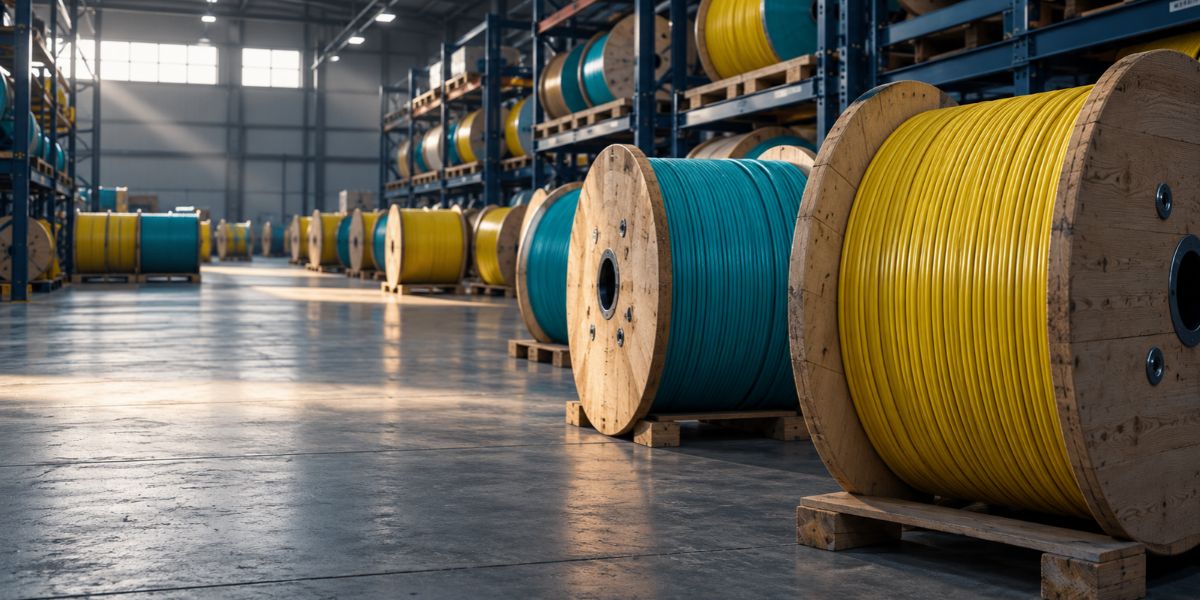
The AI build-out is absorbing the world’s fibre supply. If next year’s refresh assumes cable arrives in a few weeks, the plan is already behind.
TL;DR: The AI data centre build-out is absorbing the world’s fibre supply, and as of May 2026 fibre lead times had stretched to around 20 weeks for volume buyers. A 2027 cabling refresh in South Africa should now be treated as a long-lead project: specify it to last, order early, and make the budget case on scheduling risk rather than spend.
For most of the past twenty years, cable was the easy part of an infrastructure project. You designed the plant, placed the order, and the drums arrived in a few weeks, usually well before the installation team needed them. Programme risk sat elsewhere: in power, in cooling, in getting sign-off.
That assumption no longer holds.
Why is fibre optic cable taking months to arrive?
The global build-out of AI data centres is consuming optical fibre faster than manufacturers can produce it. As of May 2026, industry reporting put fibre lead times at around 20 weeks for volume buyers, and up to a year for smaller ones. Fibre prices had risen roughly 70% since 2021. Data-centre demand for fibre grew about 76% in 2025 alone, and is heading towards 30% of global demand by 2027.
The pressure has not eased since. In July 2026, Corning, one of the world’s largest optical fibre manufacturers, reported enterprise network sales up 65% year on year, alongside a multiyear supply agreement with a hyperscaler and plans to expand manufacturing capacity substantially. New capacity is being built. It is not yet producing, and until it is, the largest buyers are first in the queue.
These are international figures, and local lead times vary by product, volume and supplier. But the direction is not in doubt: South African buyers draw from the same global supply.
Why does AI use so much fibre?
Last month, in What AI-Ready Infrastructure Actually Means for Your Business, we looked at the pressures AI adoption is putting on infrastructure: power, cooling, bandwidth, compliance and physical security. Of the five, bandwidth is the one behind the fibre shortage. AI systems move enormous volumes of data between compute and storage, and that data travels over cable.
The scale is striking. According to fibre manufacturer STL, an AI rack uses roughly 36 times the fibre of a conventional server rack.
The reason is architectural. In a conventional server room, each server needs a handful of connections, and most traffic flows up to the core and out to users. In an AI cluster, thousands of processors have to work together as a single system, constantly exchanging data with each other at very high speed. That calls for many more high-bandwidth optical connections per rack than a conventional design.
Multiply that across data halls with thousands of racks, and it becomes clear where the world’s supply is going.
How do longer lead times affect a 2027 cabling refresh?
For most organisations, the issue is not competing with hyperscalers for AI fabrics. It is that everyone buys from the same factories.
If your 2027 plan includes a backbone upgrade, a new comms room, a white space fit-out or a campus expansion, cable is now a long-lead item, alongside UPS systems, generators and switchgear. A project that assumes materials in six weeks and a first-quarter installation window can find itself waiting until the third quarter for the drums. Contractors, access windows and change freezes are then re-planned around the delay, and every re-plan costs money.
The practical consequence is simple: a refresh approved in 2027 and ordered in 2027 may not be installed in 2027. The decisions that set next year’s timeline are being made in this year’s budget cycle.
How do you specify cabling so you only buy it once?
When cable is scarce and expensive, the worst outcome is installing a plant that has to be replaced again at the next refresh. Cabling is the longest-lived layer in the building. It typically outlasts several generations of the equipment plugged into it, and it is the most disruptive layer to replace while a site is live.
A few principles help a cable plant last:
- Size pathways for the future. Cable trays, containment and conduit are cheap to oversize now and expensive to add later. Leave room for the next installation, not just this one.
- Plan the backbone for growth. Singlemode fibre supports higher speeds over longer distances than multimode, which gives the backbone more room to grow.
- Install spare capacity. Additional strands in a backbone trunk cost little at installation. Pulling a new trunk through a live building later costs a great deal.
- Consider pre-terminated trunks in data centre environments. They shorten installation time on site and make future changes cleaner.
- Document and label everything. A plant nobody can trace is a plant that gets ripped out rather than extended.
Should you use fibre or copper cabling?
None of this means everything should be fibre. Copper remains the right answer in more places than many assume.
Category 6A copper is still the practical choice for horizontal runs to the work area, within the standard 100-metre channel. Its biggest advantage is power. Power over Ethernet carries electricity and data down the same cable, which is why it is widely used for wireless access points, IP cameras, access control readers and a growing list of building systems. A camera on a perimeter pole or a card reader on a server room door does not need a separate electrical supply if the cabling is designed for it.
Fibre belongs in the backbone between floors and buildings, in data centre environments, on runs beyond copper’s distance limits, and where electrical interference is a concern. A well-designed plant uses both, each where it does its job best.
How do you justify infrastructure spend in a flat budget?
Gartner forecasts 2027 IT budgets to grow by around 3.7%, below inflation, while spending on AI grows far faster. For most infrastructure owners, that means the physical layer is competing for a shrinking share.
The case for funding it is simple: everything else depends on it. AI workloads, new wireless coverage, security upgrades and building management systems all run over the cabling infrastructure. A refresh deferred to save budget this year can delay every project that sits on top of it next year.
Three things strengthen the case:
- Frame it as risk, not spend. A 20-week lead time turns a deferred refresh into a scheduling exposure rather than a saving.
- Separate ordering from installing. Long-lead materials can be secured early and installed in phases as budget releases.
- Prioritise pathways and backbone. Get the long-life, hard-to-change layers right first. The rest can follow.
Will the fibre shortage ease?
The fibre shortage should ease as new manufacturing capacity comes online. Until it does, the organisations that stay on schedule will be the ones that treat cabling as a long-lead item and plan accordingly.
If you are planning a cabling refresh, a comms room upgrade or a white space fit-out for 2027, we can help. With more than 40 years in the industry, we offer a comprehensive infrastructure assessment to establish what your existing cable plant and pathways will support, what needs replacing, and what should be ordered now. Contact us to arrange one.
Frequently asked questions
How long does fibre optic cable take to order in 2026?
As of May 2026, industry reporting put fibre lead times at around 20 weeks for volume buyers, and up to a year for smaller buyers. Local lead times vary by product, volume and supplier, but South African buyers draw from the same global supply.
Why is there a fibre optic cable shortage?
AI data centres are consuming fibre faster than manufacturers can produce it. According to STL, an AI rack uses roughly 36 times the fibre of a conventional server rack, and data-centre demand for fibre grew about 76% in 2025 alone.
When should I order cabling for a 2027 project?
Treat cabling as a long-lead item and plan it in the 2026 budget cycle. A refresh approved and ordered in 2027 may not be installed in 2027. Long-lead materials can be secured early and installed in phases as budget releases.
Is Cat 6A copper cabling still worth installing?
Yes. Category 6A copper is still the practical choice for horizontal runs to the work area within the standard 100-metre channel, and Power over Ethernet lets it power wireless access points, IP cameras and access control readers over the same cable.
Should a cabling backbone use singlemode or multimode fibre?
Singlemode fibre supports higher speeds over longer distances than multimode, which gives the backbone more room to grow.
What does an infrastructure assessment cover?
It establishes what your existing cable plant and pathways will support, what needs replacing, and what should be ordered now.
Sources
- AI data centers are consuming fiber optic cable faster than suppliers can make it – Tom’s Hardware, 16 May 2026 (citing STL)
- Corning’s Strong Second-Quarter 2026 Financial Results – Corning, 28 July 2026
- CIO Planning for 2027 – Gartner
- What AI-Ready Infrastructure Actually Means for Your Business – Advanced Infrastructure, 7 September 2026